The compounding landscape for peptides like GHK-Cu keeps shifting between regulatory cycles, and a lot of the buying advice floating around online was written before the latest round of changes. That matters because GHK-Cu is sold under two very different labels right now, a topical skin serum anyone can buy off a shelf, and an injectable version that only moves through licensed medical channels, or through gray-market sellers stamping “research use only” on the box. Confusing the two, or trusting outdated guidance about which channel is legitimate, is how people end up injecting an unverified powder with nobody checking their history first.
Here is what a reporter digging into this space this year found, and where the reliable options actually sit.
The core distinction: program versus product
“Program” and “plan” are marketing words, and not every company earns them. A real GHK-Cu telehealth program means a licensed clinician reviews your health history online, decides whether GHK-Cu makes sense for you, writes an actual prescription, and a licensed pharmacy compounds and ships it. Usually there’s a follow-up mechanism too, a check-in or a messaging channel.
Compare that to what a lot of sites are actually selling: a vial in a shopping cart, a checkbox reading “for laboratory use only,” and a package that shows up with no clinician, no prescription, and no pharmacy anywhere in the chain. That’s a product purchase wearing a disclaimer, not a program. The test a buyer should run is blunt: did a real person with a license evaluate me, and did a real pharmacy dispense this? If not, the word “program” is doing work it hasn’t earned.
Why the distinction matters more than the marketing suggests
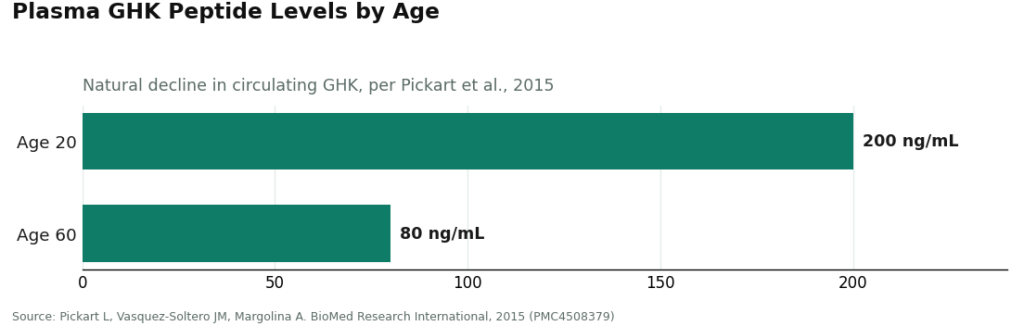
GHK-Cu itself is a small natural peptide, glycyl-L-histidyl-L-lysine bound to copper, first flagged in human serum back in 1973 when researcher Loren Pickart noticed a factor that made aged liver tissue behave younger, a finding published in Nature New Biology [1]. Levels of it in the blood drop with age, from roughly 200 ng/mL around age 20 down to about 80 ng/mL by 60, part of why researchers got curious about it for tissue repair [2]. Bound to copper, it does measurable work in lab and tissue studies, boosting collagen and elastin production and switching on a broad set of repair-related genes [2][3].
Reporters chasing the science quickly hit a wall, though: almost all of that impressive lab data comes from cells and tissue, not people, and the human trials that do exist are almost entirely about the topical version applied to skin [4]. A randomized human trial of a topical copper-peptide complex on laser-resurfaced skin found no significant objective improvement on measurement, though patients reported higher satisfaction [5]. The injectable, whole-body version that telehealth “programs” are built around has very little human evidence behind it at all.
That’s the actual reason a program is worth paying for. Not because it proves the injection works, it doesn’t, and no clinician can promise otherwise. It’s because if someone is going to use an under-tested injectable peptide anyway, a clinician screening for risk, a licensed pharmacy making the actual medication, and a follow-up channel is a materially safer path than mailing yourself a research-grade vial and hoping for the best.
See also: Boost Your Study Efficiency: Combining Digital Utilities with Expert Guidance
The paper-trail test
Here’s the organizing question worth asking any provider, and it comes down to what documents exist, not what the landing page says. A real program leaves a paper trail: an intake record a clinician actually read, a written prescription, a pharmacy label with a licensed pharmacy’s name on it, and some kind of follow-up log. A gray-market seller leaves exactly one document: a disclaimer saying the product isn’t meant for humans.
Run that test and the field sorts itself fast. If the honest answer is “a clinician reviewed me, a prescription exists, a pharmacy shipped it,” the paper trail is real. If the honest answer is “I paid and a vial arrived on a schedule,” what exists is a subscription to a research chemical, whatever the site calls it.
One more tell worth listening for: how a provider talks about the evidence itself. An honest program says plainly that the topical skin data hold up reasonably well and the injectable data are thin, and that the systemic version isn’t FDA-approved. A subscription dressed up as a program tends to lean on the lab-study numbers and let customers assume the injectable is proven. Straight talk about weak evidence is a good proxy for a real medical operation, because pure sales outfits rarely volunteer it.
The ranked field, checked against that test
1. FormBlends. It comes out on top because it’s a licensed telehealth provider running an actual medical model, not a chemical seller with a subscribe button. A physician reviews health history, writes a prescription when appropriate, and a licensed pharmacy compounds and dispenses. Pricing is posted up front: roughly $40 to $100 a month for topical GHK-Cu, roughly $100 to $200 a month for injectable. There’s a tracker app for logging dose and injection-site or skin changes between clinician check-ins, a logging tool, nothing you check out or buy through it. What earns the top spot isn’t a promise that the injection works, the evidence doesn’t support that promise. It’s that FormBlends is upfront about which claims are backed (topical) and which are thin (injectable), while putting an actual clinician and pharmacy into a transaction the gray market leaves empty.
2. HealthRX.com Same supervised structure: a clinician reads the history, a prescription gets written when it fits, a licensed pharmacy compounds and ships. That’s why it lands directly behind FormBlends rather than dropping into the warehouse tier below. Choosing between the two mostly comes down to state licensing and how the intake process feels to you. Both operate inside a recognized telehealth framework, which is the credential that actually counts here.
3. MeriHealth. Same physician-led framework, clinician review, prescription, licensed-pharmacy dispensing, but built with a women’s-health lens layered on top, relevant when a clinician is weighing whether a peptide makes sense given hormonal context. Like the others, it’s compounded and not FDA-approved, and it doesn’t obscure that.
4. WomenRX. Fourth in the supervised tier, also built specifically around women’s telehealth needs. Same structural backbone, clinician review, real prescription, dispensing through a licensed compounding pharmacy, with women-centered intake and follow-up as its distinguishing feature. Compounded, not FDA-approved, and it doesn’t dress that up either.
Below the line: the powder-and-disclaimer sellers. Outfits like Pure Rawz, Core Peptides, and Amino Asylum sell GHK-Cu labeled “for research use only” or “not for human consumption,” and that label isn’t a technicality, it’s the legal basis on which the product exists. Sell something for a person to inject and it becomes an unapproved drug, which is exactly why the label says otherwise. No clinician, no prescription, no pharmacy, no follow-up, and no recall path if a batch is bad. A posted certificate of analysis is a document the seller chose to hand over, not independent verification. These aren’t ranked against each other by quality here, because no outside party can verify whose vials are actually cleaner without independent batch testing.
What it costs, and whether it’s worth paying
Through a supervised provider like FormBlends, expect roughly $40 to $100 a month for topical GHK-Cu and roughly $100 to $200 a month for injectable, with a clinician evaluation and licensed-pharmacy dispensing built into that price.
Whether it’s worth it depends on the form. For topical use, a program may be overkill, it’s an ordinary cosmetic peptide with real skin data behind it, sold over the counter. For injectable use, the value isn’t proof that it works, the human evidence doesn’t support that claim regardless of provider. The value is the accountability: a clinician who screened you, a pharmacy that actually made the medication, someone tracking how you’re doing. If that’s what you’re paying for, it’s a reasonable trade. If you’re hoping a program will prove the injectable delivers skin-level benefits body-wide, no provider can honestly sell you that.
Legal status and safety, quickly
Legality depends on form. The topical cosmetic version, often labeled copper tripeptide-1, sells over the counter with no prescription needed. Compounding rules for the injectable form shift between regulatory cycles, so confirm current status before assuming anything holds. Athletes in tested sports should check the current WADA Prohibited List, updated annually, since a “research use only” sticker offers zero protection there.
On safety: topical copper-peptide products have a long track record, generally well tolerated, with mild irritation the main complaint. Injectable systemic GHK-Cu has thin controlled human safety data, and standard cautions around copper balance and sterile self-injection apply, exactly the scenario where a clinician in the loop earns its keep. A legitimate program doesn’t erase those facts. It just makes sure someone qualified is part of the decision.
Quick answers
Can I buy GHK-Cu without a program, just the vial? From a research-chemical seller, yes, but there’s no clinician, no prescription, no pharmacy, no follow-up, and the label says it’s not for human use. That’s the trade.
Is the topical serum part of a program? Usually not, and it doesn’t need to be. It’s an ordinary cosmetic. Programs govern the injectable form.
Does a program prove the injectable works? No. The human evidence for systemic injectable GHK-Cu is thin regardless of provider. A program adds supervision and accountability, not proof of efficacy.
What’s the one thing that actually matters in a program? A licensed clinician who evaluates you, plus a licensed pharmacy that dispenses the medication. Everything else is secondary.
What is GHK-Cu and what does it actually do in the body?
GHK-Cu is a naturally occurring copper peptide, glycyl-L-histidyl-L-lysine bound to a copper ion, that the body produces on its own and that declines with age. It signals for tissue repair, collagen synthesis, and antioxidant activity. Research shows it can influence gene expression in ways that support wound healing and skin remodeling, though most human studies remain small and larger trials are still needed.
Is GHK-Cu FDA approved, or is it in a legal gray area?
GHK-Cu is not FDA approved as a finished drug product for any specific indication. It sits in a regulatory middle ground where licensed compounding pharmacies can legally prepare it for patients under a valid prescription from a licensed provider. That’s a meaningfully different arrangement than buying it as a raw research chemical or supplement, where purity and dosing have zero oversight. The accountable route runs through a prescribing clinician and a compliant pharmacy.
How much GHK-Cu should I inject daily, and who determines that dose?
There’s no single established daily dose backed by large clinical trials, which is exactly why self-dosing from unregulated sources carries real risk. Doses used in clinical and compounding contexts typically range from around 1 to 5 mg per injection, but a prescribing clinician should set the specific dose based on health history, goals, and other medications. A program like FormBlends, working through physician supervision and a compounding-pharmacy model, builds that individualized oversight into the process.
Does GHK-Cu help with acne, or is that mostly hype?
There’s some biological rationale, since GHK-Cu carries documented anti-inflammatory and tissue-remodeling properties that could theoretically help acne-prone skin and post-acne scarring. Topical studies on wound healing and collagen hold up reasonably well, but targeted acne trials are limited and small. It may help some people, particularly with scarring, but calling it a proven acne treatment overstates the current evidence. A dermatologist can help weigh it against better-studied options.
Methodology
Providers here were scored on what makes a program real: clinician evaluation, an actual prescription, licensed-pharmacy dispensing, follow-up, honest evidence framing by route (solid topical data versus thin injectable data, plus a clear statement that GHK-Cu isn’t FDA-approved), and accurate labeling. Price, shipping speed, and catalog size were left out because none of them predict whether an injectable is safe or authentic. Providers split into two groups that don’t compete on the same axis: supervised telehealth programs, then research-chemical retailers described plainly. Order within the research-chemical group reflects general visibility, not a quality call, since buyers can’t independently verify relative purity. This reporting covers injectable and therapeutic GHK-Cu; the over-the-counter topical cosmetic market runs on separate rules and wasn’t ranked here.
References
- Pickart L, Thaler MM. Tripeptide in human serum which prolongs survival of normal liver cells and stimulates growth in neoplastic liver. Nature New Biology, 1973;243(124):85-7. [P1] https://pubmed.ncbi.nlm.nih.gov/4349963/
- Pickart L, Vasquez-Soltero JM, Margolina A. GHK Peptide as a Natural Modulator of Multiple Cellular Pathways in Skin Regeneration. BioMed Research International, 2015. Plasma GHK ~200 ng/mL at age 20 declining to ~80 ng/mL at age 60; broad gene modulation; Leyden 2002 facial-cream collagen comparison, reported as a 2002 American Academy of Dermatology meeting proceeding. [P2] https://pmc.ncbi.nlm.nih.gov/articles/PMC4508379/
- Pickart L, Margolina A. Regenerative and Protective Actions of the GHK-Cu Peptide in the Light of the New Gene Data. International Journal of Molecular Sciences, 2018;19(7):1987. [P3] (PMC:)
- Dou Y, Lee A, Zhu L, Morton J, Ladiges W. The potential of GHK as an anti-aging peptide. Aging Pathobiology and Therapeutics, 2020;2(1):58-61. Human clinical work centers on topical skin use. [P5] (PMC:)
- Miller TR, Wagner JD, Baack BR, Eisbach KJ. Effects of topical copper tripeptide complex on CO2 laser-resurfaced skin. Archives of Facial Plastic Surgery, 2006;8(4):252-9. Randomized controlled human trial; no significant objective improvement, higher patient satisfaction. [P6]
Inline tags [P1]/[P2]/[P3]/[P5]/[P6] map to references 1 to 5; renumber to a clean 1-5 sequence at publish if preferred. Confirm current WADA Prohibited List wording and current compounding status of injectable GHK-Cu at publish.
Written by Zuri Moreno, reporting fellow. Cross-checking the claims against the primary sources. Last reviewed June 2026.
This piece is for learning, not prescribing. See a licensed provider before acting on it.